


The national AIDS Memorial Quilt is one of the most iconic symbols of the epidemic, and has been since it was first created in 1987. A stirring patchwork of personal struggles, the quilt today is comprised of over 46,000 3-by-6 foot panels, each of which tells the story of someone who has died of AIDS and showcases the long-reaching scope of this devastating disease.
A small group of students at Dwight-Englewood School in Englewood, New Jersey, were anxious to become a part of the quilt’s rich two-decade history and worked with the NAMES Project Foundation—with a generous donation from the Tommy Hilfiger Foundation—to put two of the quilt’s panels on display at the school this week. From Monday, February 25 through Friday, February 29, the Dwight-Englewood AIDS Awareness Club is sharing these two pieces of the quilt with the rest of the student body to put AIDS—literally—in the public eye.
“We do a lot of work on our level to make sure that the students here are fully educated—or as much as possible—on this disease,” says Isabella Rodrigues, 17, a junior at the school and copresident of the club. “And I think kids, especially at our school, will be able to respond to this epidemic in this quilt form.”
Accompanying each piece of the quilt on display is a reflection book, where students are encouraged to write down how the disease has affected their own lives and what seeing the quilt in person means to them.
“We’re hoping to get everybody’s response and see that people really are impacted and can find some meaning behind this quilt,” says Julia Schneider, 18, a senior at the school and copresident alongside Rodrigues. Schneider adds, “I like the idea of the art form and having the quilt hung up in the school so everyone can see it all day. And also, since it’s my last year here, I think it’s pretty awesome to see it myself.”
Advisor Jane Park, a science teacher at the school, has been heavily involved in the club’s activities—which include everything from bake sales to guest panels to Q&A sessions with positive people—for the past five years.
“I think currently the nature of the AIDS epidemic is very different than it was in the ’80s, and the youth—teenagers and young adults between 13 and 24—are one of the fastest-growing portions of new HIV cases,” says Park. “I think that lends itself to educating the public about how HIV has changed over the years and how it really affects our lives today.”
According to Park, the club has existed in one form or another since the 1980s but has significantly picked up steam in recent years. Currently, there are 25 active members in the group, but the student body comes out in full force to support the group’s cause whenever the opportunity arises.
Julie Rhoad, the executive director of the NAMES Project Foundation, which oversees quilt preservation and exhibition, sees the quilt as a vital method for teaching students about HIV/AIDS in a way that statistics never could and never will.
“There’s something huge to be said for the impact of real stories about people’s real lives, having been loved and lost, that create an extraordinary backdrop for the kind of inspirational teaching that we need,” Rhoad told POZ. “When I think about how isolating HIV/AIDS can be in all sorts of ways, and the kinds of silent stigma that surrounds this, what the quilt creates for a lot of people is a safe space. It is a safe space to talk.”
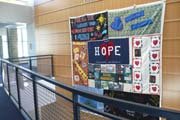 | |
| One of the AIDS Memorial Quilt panels hanging in the stairway of the Klein Campus Center |
Both sections of the AIDS Memorial Quilt are currently on display in the Klein Campus Center until Friday, when the group will host an AIDS Awareness Dinner and Concert fund-raiser. All of the proceeds will be donated to Love Heals, the Allison Gertz Foundation for AIDS Education, an AIDS service organization that benefits the greater New York City area.
The Dwight-Englewood AIDS Awareness Club remains an invaluable resource to the surrounding community, raising over $15,000 from 2005 to 2007 for local AIDS service organizations, but these tenacious teenagers—like the AIDS Memorial Quilt itself—will continue their mission to educate, inspire and keep this epidemic in perspective.
“As a club, we feel that working on a smaller level and bringing people together is really something that has benefited our community,” says Rodrigues. “And that’s what we continue to do.”


Comments
Comments