SPECIAL POZ SUPPLEMENT TO THE WASHINGTON POST
POZ EDITOR-IN-CHIEF INTERVIEWED ON "IN THE LIFE" TV
POZ Editor-in-Chief Regan Hofmann appears on a special World AIDS Day episode of "In the Life" TV with Kenneth Cole, fashion designer and chairman of the board of amfAR, the Foundation for AIDS Research:
POZ FIGHTS STIGMA WITH DECEMBER ISSUE
At POZ, we know that the stigma around HIV/AIDS can be as deadly as the virus itself. That's why we dedicated our December/World AIDS Day issue to the notion of fighting stigma.
Click here to read POZ Editor-in-Chief Regan Hofmann's letter on the deadly power of stigma.
Click here to read the feature story on stigma featuring the results of the POZ Stigma Survey.
Watch POZ December 2009 covergirl Nokhwezi Hoboyi from the Treatment Action Campaign in South Africa speak about how stigma has affected her:
Watch Eric Goosby, MD, ambassador at large and global AIDS coordinator, talk about PEPFAR, vaccines and stigma:
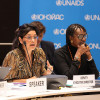
Watch Rep. Maxine Waters (D-California) discuss federal HIV/AIDS funding, the development of a national HIV/AIDS strategy, dealing with stigma and inspiring new leaders:
Watch Naina Khanna, director of policy and community organizing at WORLD, discuss stigma, the challenge of targeting limited resources to prevent and treat HIV/AIDS for women, communities of color and LGBTs:
Watch Malvin Vien and Robert Muruyama, MD, both from APICHA, discuss the challenges in the Asian & Pacific Islander communities of stigma and HIV testing:
Click here to watch videos from World AIDS Day 2008.
SPECIAL MESSAGE FROM THE PRESIDENT OF THE UNITED STATES
President Barack Obama issued a proclamation for World AIDS Day:
Our Nation joins the world in celebrating the extraordinary advancements we have made in the battle against HIV and AIDS, and remembering those we have lost. Over the past three decades, brave men and women have fought devastating discrimination, stigma, doubt, and violence as they stood in the face of this deadly disease. Many of them would not be here today, but for the dedication of other persons living with HIV, their loved ones and families, community advocates, and members of the medical profession. On World AIDS Day, we rededicate ourselves to developing a national AIDS strategy that will establish the priorities necessary to combat this devastating epidemic at home, and to renewing our leadership role and commitments abroad.
Though we have been witness to incredible progress, our struggle against HIV/AIDS is far from over. With an infection occurring every nine-and-a-half minutes in America, there are more than one million individuals estimated to be living with the disease in our country. Of those currently infected, one in five does not know they have the condition, and the majority of new infections are spread by people who are unaware of their own status. HIV/AIDS does not discriminate as it infiltrates neighborhoods and communities. Americans of any gender, age, ethnicity, income, or sexual orientation can and are contracting the disease.
Click here to continue reading the proclamation.
SPECIAL MESSAGE FROM THE CENTERS FOR DISEASE CONTROL AND PREVENTION
Kevin Fenton, director of NCHHSTP at the CDC, released this statement for World AIDS Day:
On this World AIDS Day, we are reminded that the fight against HIV is
far from over, in the United States and around the world. Every nine
and a half minutes, someone in the United States is newly infected with
HIV. One in 5 of the more than 1 million people living with HIV in this
country are unaware of their infections and may be unknowingly
transmitting the virus to others. And although available treatments
have dramatically increased the life expectancy of people with HIV, the
virus that causes AIDS, it remains a fatal disease - in 2007, more than
14,000 Americans with AIDS died. Clearly, we must keep fighting this
preventable, yet deadly disease that impacts so many Americans, and we
laud President Obama's commitment to reducing HIV incidence, increasing
access to care, optimizing health outcomes, and reducing HIV-related
health disparities.
The impact of HIV in the United States continues to be most severe among
some of our most vulnerable populations. By risk group, men who have sex
with men account for the majority of new infections and of people living
with HIV. By race/ethnicity, African-Americans and Latinos bear the
heaviest burden of disease. And although rates among Asians/Pacific
Islanders and American Indians/Alaska Natives are lower, the burden of
HIV on these communities remains significant. A range of social,
cultural, and economic factors - including stigma, racism, poverty, and
limited access to health care - contribute to the disproportionate
impact of HIV on each of these groups. And since young people in each
of these populations continue to become infected with HIV at high rates,
we must continue to reach each new generation with information and
education on how to prevent HIV from impacting their lives.
Click here to continue reading the statement.
|