

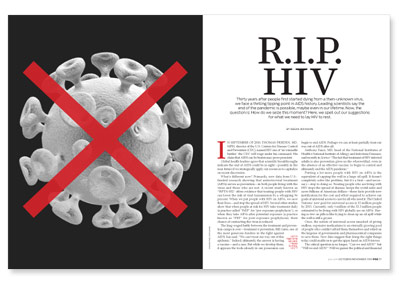
In September of 2010, Thomas Frieden, MD, MPH, director of the U.S. Centers for Disease Control and Prevention (CDC), named HIV one of “six winnable battles” the CDC will wage under his command. His claim that AIDS can be beaten may prove prescient.
Global health leaders agree that scientific breakthroughs indicate the end of AIDS could be in sight—possibly in the near future if we strategically apply our resources to capitalize on recent discoveries.
What’s different now? Primarily, new data from U.S.-funded research showing that antiretroviral treatment (ARVs) serves as prevention—in both people living with the virus and those who are not. A recent study known as “HPTN 052” offers evidence that treating people with HIV can lower the risk of viral transmission by a whopping 96 percent. When we put people with HIV on ARVs, we save their lives—and stop the spread of HIV. Several other studies show that when people at risk for HIV take treatment daily (a practice called “PrEP” for “pre-exposure prophylaxis”), or when they take ARVs after potential exposure (a practice known as “PEP” for post-exposure prophylaxis), their chance of contracting the virus is reduced.
The long-waged battle between the treatment and prevention camps is over—treatment is prevention. Bill Gates, one of the most generous funders in the fight against AIDS, has said, “We can’t treat our way out of this epidemic.” Indeed, ultimately, the answer is having a vaccine—and a cure. But while we develop them, it appears the tools already in our possession can begin to end AIDS. Perhaps we can at least partially treat our way out of AIDS after all.
Anthony Fauci, MD, head of the National Institutes of Health’s National Institute of Allergy and Infectious Diseases, said recently in Science: “The fact that treatment of HIV-infected adults is also prevention gives us the wherewithal, even in the absence of an effective vaccine, to begin to control and ultimately end the AIDS pandemic.”
Putting a lot more people with HIV on ARVs is the equivalent of capping the well in a large oil spill. It doesn’t completely solve the problem, but it’s a first—and necessary—step to doing so. Treating people who are living with HIV stops the spread of disease, keeps the world safer and saves billions of American dollars—these facts provide new justification for the cost and effort required to achieve our goals of universal access to care for all who need it. The United Nations’ new goal for universal access is 15 million people by 2015. Currently, only 6 million of the 33.3 million people estimated to be living with HIV globally are on ARVs. Having so few on pills is like trying to clean up an oil spill while the well is still a geyser.
Once, the notion of universal access smacked of giving endless, expensive medications to an eternally growing pool of people who couldn’t afford them themselves and relied on the largesse of governments and pharmaceutical companies to save them. New data suggest that doing the right things today could enable us to get the upper hand on AIDS forever.
The critical question is no longer, “Can we end AIDS?” but “Will we end AIDS?” Will we garner the political and financial capital to do what science suggests we can?
For years, we have tried various approaches to behavioral and non-biomedical prevention, with some success. But, since people continue, and likely always will, to have unprotected sex and share injection drug equipment, incidence of new infection rates is not declining and will never decline unless we stop HIV dead in its tracks. The best way to do that is to provide ARVs to the bulk of people living with HIV who need them. Modeling in several countries shows a direct correlation between increased access to care and decreased rates of new HIV infections.
There are many barriers to care. Drug prices alone are not keeping people from pills. In some nations, political unrest, lack of infrastructure and/or a shortage of medical workers mean that even if governments could afford the pills, the meds still wouldn’t get to the people. In the United States, impending federal budget cuts, inadequate state contributions to Medicaid and recent changes in eligibility requirements for Medicaid, lack of childcare and transportation, homelessness, substance addiction, mental health issues, comorbidities, health disparities, misperceptions and language barriers also present impediments to care.
And of course, fear of stigma, discrimination, homophobia, criminalization, deportation, physical harm and death undermine HIV care efforts around the world.
While these challenges are daunting, it pays to overcome them. We need to greatly expand our testing efforts and do a much better job of linking people to and retaining them in care. If many more people become aware of their HIV status earlier, and if they access care and lower their viral load to an undetectable level, then they not only improve their own health but they contribute to better public health. Connecting people to medicines before they inadvertently pass along the virus will reduce community, and possibly global, viral loads. This is how the spread of AIDS begins to slow. This is how we cap the well.
Having 27.3 million people with HIV globally (about 1 million of them in America) remain untreated with existing drugs that can save their lives and prevent AIDS from spreading is a humanitarian crime of epic proportion. It’s also no way to stop the AIDS pandemic.
Expanded access to HIV treatment, while a lynchpin in any strategy to end AIDS, will not, by itself, solve the problem. We also need to develop and distribute biomedical prevention tools (like PrEP, PEP and microbicides), scale up male circumcision and continue to distribute more male and female condoms and clean syringes. The question is one of relative proportion. Current levels of resources applied in newly focused and optimally strategic ways to reflect the insight of recent medical breakthroughs will maximize their impact and hasten doomsday for AIDS.
We can make major headway by employing our complete arsenal of tools in a way that ensures we get the biggest bang for our buck. But we can’t get blood from a stone. If we are to end AIDS, we eventually will need more money. And it needs to come from fresh sources. No nation has applied more currency to the fight against AIDS than America. At its peak, the budget for the President’s Emergency Plan for AIDS Relief (PEPFAR) was $48 billion dollars. The United States spends about $19 billion a year to fight AIDS at home. But that’s about to change as our government now faces cutting $1.5 trillion from the federal budget. That’s not a budgeting haircut. That’s a buzz cut.
As budget cuts are made, all discretionary spending and entitlement programs (which comprise the bulk of domestic and global AIDS funding) are at risk. The community of people living with HIV/AIDS and our friends must convince political, economic and global health leaders not to slash AIDS funding. We are up against those fighting for support for other diseases, education, the military’s fight against terrorism, and the dollars needed to keep Social Security secure, to name a few causes. Our cry must be particularly pointed. If we fail to defend AIDS spending, tens of millions of people will perish needlessly in the next decade.
In his opening keynote speech at the International AIDS Conference in Rome, UNAIDS executive director Michel Sidibé called gaps in access to HIV treatment an affront to humanity that can and must be closed by innovations in developing, pricing and delivering treatments and commodities. “History will judge us not by our scientific breakthroughs,” he said, “but how we apply them.”
Ending AIDS won’t be easy, it won’t be cheap, and it won’t happen overnight. But if we develop a smart, sound, strategic plan—one that uses existing resources better and secures new funding from other nations—and if we sell it all the way up the political line to the president himself and across both sides of the Congressional aisle, it can be done.
This Congress and this president have the chance to kill one of the world’s worst killers and in the process save tens of millions of people and billions of dollars. If we rapidly increase access to care, and if infection rates and deaths decline, then the resources needed to fight global AIDS could shrink in as few as five years. And, significantly expanding access to care will make the pharmaceutical companies who make the drugs even richer. I know, I know. But the answer to bankrolling the end of AIDS is not as simple as dropping drug prices. The prices set by for-profit companies are only likely to go down if the volume of drugs sold goes up. And for that to happen, we need to find more guaranteed payers. This is why the rest of the world needs to help come up with the cash to expand access to care for people with HIV.
We have a rare opportunity to rewrite the ending of one of the world’s worst tragedies. We didn’t give up when we didn’t have the answers for what can end AIDS—we certainly shouldn’t now that we do.
The bottom line? If the HIV community can encourage the world to up the antes of international financial and political will, if global advocacy efforts are bolstered and expanded, if we correctly position the arguments for why the world should spend the money to stop AIDS, if we put AIDS back in the spotlight and take it out of its silo, if we utilize existing health care and faith-based infrastructure to deliver care, if we make health care a human right that is equally offered to all, if we protect the human rights of people with HIV, if we put our money where we know it works best, and if these things result in more people getting educated, protected, tested, treated and linked to care, HIV’s days could be clearly numbered.
With that in mind, POZ outlines seven key areas where we need to focus global efforts if we are to end AIDS, and we suggest specific tactics within each of those areas.
1. POLITICAL WILL
We need to ask the president to step up his game on HIV/AIDS. President Barack Obama took a leadership position on HIV/AIDS when he made the development of a National HIV/AIDS Strategy for the United States a campaign promise. He delivered on that promise, reinvigorating the Office of National AIDS Policy, re-upping the President’s Advisory Council on HIV/AIDS (PACHA) and ushering the National HIV/AIDS Strategy to life. It exists. Now we ask: Will its implementation get funded, or will it remain merely a promise on paper? If President Obama can encourage Congress to secure the money to fight AIDS abroad and at home at levels capable of changing the course of the pandemic (which in today’s grim economy may equate to defending current spending levels or at least, minimizing cuts), he will do something no president has done before: jump-start the end of AIDS. PEPFAR is already ahead of its pledge to put more than 4 million people on meds by 2014. We’d like to see President Obama ratchet it up and officially pledge to put 6 million in care by 2013 as a “down payment” toward achieving the United Nations’ goal of 15 million in care by 2015.
Linking millions more with HIV to ARVs, coupled with being the first president to reform health care, would secure President Obama’s place in the humanitarian history books.
It would also make him a wildly popular guy at the International AIDS Conference, scheduled for next July in Washington, DC. And being popular is a very good thing for a man looking to get re-elected several months later.
We need to request that the first lady publicly state that HIV/AIDS is the No. 1 cause of death for women of childbearing age worldwide. Michelle Obama’s main platform is fighting obesity. While it is a critical issue that needs resolving, nothing kills more women ages 15 to 44 than HIV. Nothing.
The Obama administration launched the U.S. government’s Global Health Initiative (GHI); and GHI took PEPFAR under its umbrella. Since one of the GHI’s underlying principles is to “implement a women- and girl-centered approach” to health, and considering how profoundly HIV undermines the health of women and girls, HIV should remain at the top of the list of GHI’s concerns. The first lady could help ensure that happens. While we’re asking, we’d also love to see the first lady and her daughters Sasha and Malia help unfold the AIDS Quilt on the Mall in July 2012 at the start of the International AIDS Conference—a conference that the president and Congress helped bring home by lifting the ban on people with HIV traveling into the United States.
The president and first lady were publicly tested for HIV when visiting Kenya in 2006, and on her recent trip to South Africa in 2011, Michelle Obama said, “You can be the generation that ends HIV/AIDS in our time—the generation that fights not just the disease, but the stigma of the disease, the generation that teaches the world that HIV is fully preventable and treatable and should never be a source of shame.”
If there was ever a first couple that could embrace the end of AIDS as part of their legacy, the Obamas are it.
We need to encourage conservative Democrats and Republicans (yes, even Tea Partiers) to support AIDS spending stateside—and overseas. Fighting AIDS has historically been a bipartisan effort. Both sides of the aisle have seen the value of America launching a global humanitarian relief effort focused on AIDS via PEPFAR. The program built relationships between our government and foreign governments, elevated health literacy around the world and developed health infrastructure with and in other nations. In turn, those accomplishments served as sound foreign policy and were good for U.S. national security.
Regardless of what anyone thinks of the rest of his record, President George W. Bush’s decision to start PEPFAR (and Congress’s approval to fund it) saved millions of lives and made America many new friends around the world. Bush II believed that because America could help end the suffering of people with HIV/AIDS globally, it was our moral imperative to do so. Was PEPFAR perfect under Bush II’s oversight? No. Did it have questionable constrictions around certain populations like sex workers and injection drug users? Yes. Does it happen to align with some of the nations on which we are dependent for natural resources (like oil)? Yes. Did it give the religious right a direct line into vulnerable people in need of “conversion” in the developing world? Yes. But it also proved that we could get lifesaving medications to people in developing nations who need them and that they will take them as prescribed, then get healthy, survive, parent their children and contribute to the world’s economy.
I’d like to think that the current crop of Republicans could be similarly moved to see the value of fighting HIV/AIDS both abroad—and at home (because while Bush II set out to save the world from AIDS, he forgot that the United States was part of the world). However, bearing witness to Tea Party Republicans’ attitudes toward all disenfranchised people, it’s reasonable to be deeply skeptical that Tea Party leadership would be benevolent to people with HIV.
We must help them see the light. The argument for finding the money to end AIDS exists. We just have to make it compelling to everyone.
We need to support the HIV/AIDS Caucus within Congress. As we go to print, the HIV/AIDS Congressional Caucus has been strengthened. As founding co-chair of the caucus, Barbara Lee (D–Calif.) is leading the charge to keep Congress abreast of HIV/AIDS issues. To date, there are 50 members in the caucus, including: caucus co-chairs Trent Franks (R–Ariz.) and Jim McDermott (D–Wash.), as well as notable newcomer Jim Himes (D–Conn.) and AIDS heroine Nancy Pelosi (D–Calif.). Currently, two new pieces of AIDS legislation are on the Congressional table. They include: H.R. 1462, the National Black Clergy for the Elimination of HIV/AIDS Act of 2011, re-introduced by Charles Rangel (D–NY) and Senator Kirsten Gillibrand (D–NY); and H.R. 2704, the Justice for the Unprotected against Sexually Transmitted Infections among the Confined and Exposed (JUSTICE) Act (introduced by Lee). Another bill, the Repeal HIV Discrimination Act, is scheduled to be introduced by Lee in September. With the help of this bipartisan caucus, we have a better shot at educating more members about why these bills are essential and must be passed. Not to mention that the caucus will be critical as we struggle to protect AIDS funding.
We need to start an AIDS PAC. Washington, DC, is a transactional town. If we expect members of the House of Representatives and Senate to go to bat for us, we need to ensure they get re-elected. “PAC” stands for political action committee and refers to a private group of people who organize to elect political candidates or to advance certain issues and/or legislation. A political committee is so named when the organization receives donations, or makes them, in excess of $1,000 for the purpose of influencing a federal election. In short, an AIDS PAC allows us to put our money where our mouths are. We can ask, but money really talks.
2. MONEY
We need to secure the money we have and raise more soon to avoid needing a whole lot more later. Almighty greenbacks, euros, yen, pesos, rands or rupees. Call your dinero anything you want—we must defend our earmarks and find more funding if we can. This is challenging during an economic crisis. However, if we’ve learned anything from our current state of economic affairs, it’s that ignoring problems in the short term ensures they can reach catastrophic dimensions down the road.
As Anthony Fauci said at a meeting of the U.S. Mission to the United Nations this summer, “Either you are going to pay a lot now [to end AIDS] or an awful lot later on.” The piper will be paid one way or another. We can either pay with cold, hard currency or with tens of millions of lives.
Modeling conducted by Bernhard Schwartlander, MD, UNAIDS director for evidence, strategy and results, shows that if we invest and maintain the $46.5 billion needed over the next 10 years to make the United Nations’ universal access goal a reality, new HIV infections would be reduced by 12.2 million between 2011 and 2020, a cumulative 7.4 million deaths from AIDS would be averted during that time and 29.4 million life years would be gained. The $46.5 billion investment would pay for itself with savings incurred from averted infections and their associated cost of treatment.
The more quickly we act, the better our long-term outcomes and the more money we’ll save to apply to other problems at home and around the world.
We need to encourage the U.S. government to remain a leader in global funding for HIV—in order to encourage other countries to pony up. It was never the United States’ intention to pick up the tab for ending AIDS. PEPFAR was designed so that the countries we helped could eventually sustain their own AIDS relief efforts. Our long-term strategy needs to shift the monkey of paying almost entirely for AIDS off the backs of the U.S. government and American tax payers and spread the enormous cost among all those who will benefit from the demise of AIDS.
This isn’t happening. The Global Fund to Fight AIDS, Tuberculosis and Malaria is essentially flat funded. Some nations are refusing to meet their pledges (Italy, for example, is $192 million in arrears); some have reduced their pledges; and some are paying far too little given their relative wealth and dependency on the fund.
More of the G8 and G20 countries must be convinced to get some skin in the AIDS game. The world needs to find a way to hold donor nations accountable to their Global Fund commitments, and we must see an increased investment in bilateral and multi-lateral aid. Affected countries with big GNPs should be required (and pressured by in-country advocacy efforts led by people with and affected by HIV) to dedicate more resources to their own epidemics. The Global Fund’s policy review process needs to be refined; we need to get more strategic about HIV-related granting. All donors and affected countries should reallocate their HIV portfolios to maximize impact and to ensure investment in what we know works in any particular area or nation (for example, male circumcision or prevention of mother-to-child transmission in certain African nations).
We should encourage the United States to demonstrate it is prepared to do what it expects other nations to do: find the funds to provide health care for their citizens with HIV. About 950,000 of the estimated 1.2 million Americans living with HIV are not on antiretroviral medicines (ARVs) for a variety of reasons. A good way to inspire other nations to contribute to the global AIDS fight would certainly be providing care for our citizens. By doing so, we could also show that when enough people are on ARVs consistently and that when this expanded access is coupled with awareness, testing and prevention efforts, AIDS can be wiped out.
The Affordable Care Act, a.k.a. health care reform, should address much of the gap in access to care in the United States, but reform doesn’t fully kick in until 2014, and even then, it won’t solve all of the health care concerns of people living with the virus domestically.
So far, the president and Congress have released emergency funding to meet the growing need of the AIDS Drug Assistance Program (ADAP). And the pharmaceutical companies that manufacture the drugs have dropped prices and increased funding for their Patient Drug Assistance Programs. But the recent waves of emergency funding are not a long-term solution. As we wait for health care reform, we must ask the president and Congress to continue to preserve AIDS funding. We need to ensure states are pulling their load and that they are using their funds most efficiently. And we need to ask our community to make some difficult choices and to make the money we already have work harder.
The depth and breadth of the president’s commitment to HIV/AIDS will be challenged as recommendations for discretionary and entitlement budget cuts land on his desk. The U.S. political system is not structured to reward long-term planning and decision making on the part of politicians. Many politicians have no choice but to cater to their largest donors short term to secure re-election. This is true, even for the president of the United States. And the Supreme Court’s ruling that private corporations could give unlimited funds to politicians made it more challenging for elected officials to support what’s good for the public, the nation and the world, as opposed to what’s good for the special interests of their biggest backers. That’s not conspiracy, that’s the way the system currently operates.
This means the president is in a pickle. If he fails to get re-elected, it is possible (and likely) that Republicans will abolish his legacy of health care reform. That means people with HIV will be in deep trouble since the majority of us rely on entitlement programs like Medicaid, Medicare and the Ryan White CARE Act for meds. But in order to get re-elected, the president may have to make some budget cuts that could prove disastrous short- (and possibly long-) term for many disenfranchised people—including many people living with HIV/AIDS. We need to help him understand that this short-term thinking will kill people, cost more money long-term—and backfire when it comes to Election Day.
We need to engage the private sector to help raise new money for HIV/AIDS. Corporations could play a hugely important role in bringing in-kind services and resources to the fight against HIV/AIDS. There are myriad ways multi-national corporations can leverage the reach, resources and the power of their brands to capture people’s attention and link them to lifesaving care. Corporations can deliver information or tools for health, leverage connections and media platforms or underwrite micro-lending programs to help people with HIV secure jobs, incomes and health insurance.
We also need innovative financing solutions that allow the general public to make micro-contributions to the AIDS cause. A prime example is “Massive Good”—a program launched by the Millennium Foundation for Innovative Finance for Health. Massive Good utilizes a global network of travel agencies to allow travelers to add two dollars to hotel or flight reservations. The money is passed to UNITAID, which buys AIDS drugs in bulk and helps get them to those in need. Another example is AIDS United’s recently launched “Make It Grow” campaign that also solicits micro-donations from individuals—donations that are matched dollar-for-dollar by Social Innovation Fund federal government grants. That program also supports access to AIDS meds for those who can’t afford them.
We need to broaden our fund-raising appeals beyond the usual suspects when it comes to targeting philanthropic foundations. The Bill & Melinda Gates Foundation, the Elton John AIDS Foundation, the Ford Foundation, the MAC AIDS Fund and others have contributed gigantic amounts of cash to the AIDS fight. But we must solicit new philanthropists and charitable foundations, directing our pitches at foundations beyond those that focus on funding health care. We need help with policy, advocacy, media, technology and education. And, our message should be that those who invest today in the fight against AIDS have a chance to end suffering on a biblical scale. And who doesn’t want to be a hero of epic proportion?
We need to whip up Wall Street. We should re-engage the investment community and convince the big money crowd that substantial investments in AIDS research science now could not only make investors richer but also secure them a legendary place in history for fast-tracking the cure and a vaccine. There is no longer a rationale for the existence of the “Valley of Death” (as the gap between funds needed to develop basic science and funds needed to bring drugs to market is known). Indeed, eliminating the Valley of Death is likely to save tens of millions of lives—while potentially generating billions of dollars.
We need to address the pricing issue of AIDS drugs to allow more people access to lifesaving care. The 27.3 million people not in care represent a potentially huge global expansion market for HIV drugs—a market that could bring billions to the for-profit drug companies, even if they reduced their prices. The trouble so far is that no one has been able to guarantee a payer for that market. We need to find a way to make it more profitable for pharmaceutical companies to get the drugs to more people—people who can’t pay for them themselves. It’s a conundrum.
If the cost burden for universal access to care falls solely onto governments (particularly the U.S. government) and the for-profit companies that manufacture the pills, then these entities don’t have a significant economic incentive to encourage more global expansion to care.
We need a more sophisticated strategy for asking pharmaceutical companies to reduce their drug costs. Just because their products happen to provide humanitarian relief does not, apparently, mean that pharma is obligated to manufacture or distribute them at lower prices. There needs to be a financial incentive. We need innovative financing solutions that tap fresh sources of money, and we need more support from the G8 and G20 countries, the private sector and citizens of the world. If we could gather a pool of cash in order to make universal access feasible, we could go to the table with pharmaceutical companies and negotiate for more compassionate pricing.
Advocates for the AIDS Drug Assistance Program (ADAP) have shown that a model exists for lowering drug costs in order to get more pills to more people and grow profits. The Clinton Health Access Initiative and the work being done to engage pharmaceutical companies in international patent pools will prove key to ending AIDS.
3. ADVOCACY
We need to mobilize a coordinated, effective, relentless advocacy effort that puts bipartisan pressure on the White House and local and state officials. There’s a policy wonk expression known as “grasstops,” which means, loosely, “from the grassroots to the top of the decision-making pyramid.” We need to launch a kickass, grasstops AIDS advocacy effort.
It’s important to ask the president to take a global leadership role on HIV/AIDS, and to solicit Congressional support, but they can’t do it alone. The HIV/AIDS community needs to make a lot more noise. The squeaky wheel always gets the grease, and as we head into “Budgetgeddon” (our name for the end of federal funding as we know it), we have serious work cut out for us.
We can’t be afraid to try to change the minds of our staunchest opponents. We need to pile into the offices of those most averse to discussing the issue. And stay there until they talk with us. Someone’s got to get to Speaker John Boehner and Congressman Eric Cantor and enlighten them on AIDS. We must reach out beyond the usual suspects of our friends and members on the appropriations committees. Those people are important. But we need new friends, too.
In order to maintain old friends and make new ones on both the state and federal level, many of us need to call them frequently, share our personal stories, get mad when they let us down and thank them when they don’t. We also need to be singing the same song. More streamlined and better coordinated advocacy messages are critical. We also need to put price tags on our “asks” and be able to substantiate savings where possible.
We need to ask famous, rich, powerful people to lend us their access and leverage in order to get to members of Congress who may not want to hear from us. Once, the people fighting for HIV/AIDS funding on Capitol Hill ran Wall Street, Hollywood, Broadway, Seventh Avenue and the global media. Tragically, many of them have passed away.
We need to engage new heroes and heroines, including people with ties to Republicans and Tea Party Republicans. We also need to ask for the support of the influential and powerful LGBT men and women in the world to help us get deep inside Capitol Hill again. HIV continues to disproportionately affect LGBT people, and HIV-related discrimination intersects with LGBT discrimination. The HIV and LGBT camps must align again to fight together for human rights and push the notion that health care is a human right.
We need to come together with other disenfranchised groups and threaten to swing the vote. The most disenfranchised often have the least political power. But we do have the power to vote. The HIV community needs to make it clear that if money for AIDS disappears, so does our vote. And we all must be registered. A group of 1.2 million does not a swing vote make, but if we band together with our disenfranchised peers (the unemployed, the elderly and others who depend on Medicaid and Medicare), we have a shot at rocking the vote. Bound together with others, we all stand a better chance of survival.
Health care reform is the most likely way for our country to be able to address the AIDS epidemic stateside (and the health concerns of other disenfranchised people); we must ensure that the Affordable Care Act is implemented. To do that, we must help our current president get re-elected. This is part of what it will take for the president to have the fortitude to defend health care budgets: millions of angry Americans who will unseat him if he fails to protect our lives.
We need to get angry again and let it show. Those who can access care have been lulled into a false sense of security by a flush economy and many effective treatment options. But those days are gone. Make no mistake, we are now fighting for our lives all over again. I know that so many of us are tired from waging a long battle. But we need to get furious that tens of millions of our brothers and sisters are at risk for illness and death even as we swallow lifesaving pills. We also should realize that all of us currently in care are not far from being without care. We need fear and anger over the injustice of health inequities to fuel our fight again. We need more theater, more outrage. More fake blood, more die-ins, more faux coffins. Or else those things will come our way in their all-too-real forms. When an advocacy group says “jump” we need to do so. Phone calls to Capitol Hill are free. There is no reason tens of thousands of us can’t make them, and make our representatives hear our fury.
Those of us with advocacy experience need to help others around the world launch advocacy efforts in their nations. If we’re ever to get the G8 and G20 countries on board, there needs to be more activism in the nations most capable of and likely to contribute to the global AIDS fight. Those of us who’ve been doing this work for a long time must teach those new to the fight—and we must fight on behalf of those unable to advocate for themselves.
4. THE MEDIA We need to refocus attention on HIV/AIDS and make it a critical cause again. In 2011, AIDS lost one of its greatest heroines with the passing of Dame Elizabeth Taylor. We’ve lost so many over the years. Thankfully, we still have amazingly stalwart and remarkably generous friends like Bono, Sir Elton John, Magic Johnson, Annie Lennox and others.
For AIDS to stay on the cusp of collective social consciousness, we need to bring it back into the spotlight. And to do that we need the familiar talent to make a high-profile comeback and new talent to take the AIDS stage. Maybe Taylor Swift can get on board. Usher. Justin Bieber. Selena Gomez. The casts of Glee, Vampire Diaries and True Blood.
Then there’s always the Holy Grail of Gaga. Can you imagine what it would do for AIDS awareness if Lady Gaga tweeted regularly about the virus to her Little Monsters? All 10 million of them.
We need to encourage leaders in the media, including social media, to hop on the AIDS bandwagon, too. We need to educate a whole new generation of reporters and producers about both the importance of mainstream coverage of HIV/AIDS and how to do it sensitively, accurately and compellingly. We can help the media by building relationships with them, sharing our lives and working with them on local, national and global stories. Quick, someone pitch a Current TV show on HIV/AIDS! And let’s get an HIV-focused show on OWN (the Oprah Winfrey Network). Anderson Cooper, can you please talk about AIDS a whole lot more? Maybe Google will use its logo to save lives. How about a little Google AIDS love on National HIV Testing Day or World AIDS Day? We need to create AIDS awareness, testing and treatment campaigns for YouTube and Facebook that go as thoroughly viral as HIV itself. Let’s leverage the new forms of media to their fullest potential and put frank, accurate information about how to have safe sex onto Tumblr, dating and porn sites to spread the word, not the virus. And can we please use iPads as mobile, handheld med schools? Let’s create a whole series of continuing education about HIV prevention, testing and care and broadcast it to the world’s health care workers via tablets. And let’s galvanize a whole new generation of youthful activists to join the fight.
We need to re-engage the worlds of art, music, theater, fashion and design. Looking at galleries, auction houses, lyrics, MTV, theater and magazines today, one wonders if AIDS is out of fashion.
When Larry Kramer accepted his Tony Award earlier this year for Best Broadway Revival for The Normal Heart, the national and international spotlights were, for a brief moment, again on AIDS. We must ask our talented, stylish friends to help us keep it there. Quick, someone call Marc Jacobs, Tim Gunn and Ms. Wintour. AIDS must be in vogue again, literally and figuratively!
5. THE CHURCH We need the blessing of the church. The Roman Catholic pope, Benedict XVI, has come closer to sanctioning the use of condoms than any other papal leader. While we recognize it’s unlikely he will ever get all the way there, we need to remind him that if he could, it would create a paradigm shift in how we stop AIDS from spreading. We don’t think God wants people to get HIV or die of AIDS. If the pope is a conduit for God’s word, can’t he tell Catholics it’s OK to save their lives and protect others? Denying that people have sex and telling people the only way to protect themselves sexually is to abstain from sex is killing them. This doesn’t seem very Christian, does it? Helping keep the sick alive, however, does.
We need to leverage the global network of faith-based organizations of all types to spread the good word about HIV. We should work with churches of all denominations to disseminate lifesaving information about HIV/AIDS around the world. Faith-based organizations can play an enormously pivotal role in the end of AIDS. They offer safe spaces, are led by trusted elders and are visited by people from all socio-economic tiers on a weekly, sometimes daily, basis.
Leveraging faith is a great way to reach people who do not intersect with the health care system, and it’s a wonderful vehicle to deliver messages of empowerment, health and tolerance.
There are far more churches in the world than medical centers. There is also a greater chance of people confiding in their pastor, priest, rabbi, iman or guru than coming clean with their medical doctor, nurse or health care provider.
Tolerance—of gay people, sex workers, transgender people, injection drug users and other marginalized populations—especially within houses of worship is key to making it possible for those who need medical help to get it. Can we get an “amen”?
6. HUMAN RIGHTS
We need to fight stigma, discrimination and the criminalization of people with HIV. Nothing is perhaps harder, or more critical, than removing the very real emotional barriers to testing, linkage to care, retention in care, adherence and disclosure.
It’s difficult enough to face a life-threatening illness. It’s that much harder without the understanding, support and compassion of friends, family, lovers and community. No one who has HIV did anything wrong. There is no shame in having HIV. Those living with HIV who have come to terms with their diagnosis can help newly diagnosed people accept their serostatus and overcome the self- and societally inflicted stigma that beats us down.
Everyone living with the virus needs to be educated and empowered to know that there are many good laws protecting against HIV-related discrimination. And we need to ensure that those laws are upheld, that new ones are created as needed and that unjust laws (such as those criminalizing people with HIV) are stricken off the books. And those of us who suffer injustices need to have the courage to come forward and prosecute those who commit the injustices.
We need to fight the increased incidence and severity of criminalization of people with HIV. The laws currently in place are sufficient to cover the rare cases in which a person with HIV intentionally attempts to infect another person. There is no need for AIDS-specific laws. They backfire and present hurdles to individual and public health. Who would want to get tested for HIV if knowing your status could mean you could be falsely accused of non-disclosure and end up in prison? Criminalization of HIV doesn’t protect anyone, but it does increase the risks for everyone.
We need to fight racism in the context of HIV/AIDS and the health disparities it creates. Because of racism, marginalized populations get disproportionately inadequate health care. No state and no nation should be allowed to offer inequitable health care, or reduced access to people simply because they don’t have as much money or political power as others. The arguments must be clearly made on Capitol Hill that health care is a human right—and everyone deserves equal human rights. Currently, African Americans and Latinos are disproportionately impacted by HIV/AIDS in the United States; they are nine and three times more likely, respectively, to contract the virus than whites.
We need to fight homophobia in the context of HIV. Homophobia is as dangerous as racism and similarly impedes individual health and therefore public health. When we allow large swaths of society to remain sick and when we drive entire populations underground, we give up the opportunity to improve the health of our nation as a whole—and that leaves everyone more vulnerable. Because in the real world, people don’t stay in their corners. People move around and interact. HIV doesn’t know your race, ethnicity, gender, sexual orientation or socioeconomic status. It is a biological agent that can move between any two people who engage in certain activities, and those certain activities have never been the exclusive domain of any one type of person. Sex and drug use seem to be pretty universal.
We will never end AIDS if LGBT people around the world don’t feel safe coming forward to get educated about prevention, get tested for HIV and get care if needed.
We need to stop talking about HIV in terms of “risk factors.” We must reframe the way we describe who may be at risk for HIV. While acknowledging that certain groups are at higher risk than others (for example MSM, African Americans, injection drug users, etc.) we must change the misperception that only people at high risk for HIV can contract the virus. The fact is, anyone who has ever had unprotected sex, received a blood product or an organ or shared injection drug equipment may have been exposed to HIV and should be tested.
Doctors should no longer use risk-sorted behavior to determine whether or not someone may have been exposed to HIV. Most people should be tested at least once. Some people should be tested regularly.
We need to take HIV/AIDS out of its silo and “normalize” the virus/disease. The very thing that helped HIV get emergency funding in the early days is impeding our ability to end the pandemic: AIDS exceptionalism.
We need to mainstream AIDS care. As more people living with HIV globally are tested and diagnosed, we’re going to need a lot more medical care workers. And, most people don’t get diagnosed with HIV in an infectious disease specialist’s office. They discover their status in community health centers, emergency rooms, at the OB/GYN and in other medical settings. We need a better system for linking people to HIV-specific care and retaining them in it. But we also need the general health care system to be better equipped to handle HIV.
Every doctor needs to know how to test for, deliver a diagnosis of and offer basic treatment for HIV. And we need to educate nurses too since in many nations around the world, nurses administer the lion’s share of health care.
We need to make testing guidelines clear, make testing more affordable and consider an over-the-counter HIV test. Guidelines that don’t align are confusing to doctors and present an “out” for them to HIV testing. Currently, the Prevention Task Force and the CDC guidelines don’t align. We need to fix this.
7. THE CURE
We need to support a research agenda that could fast-track a cure and a vaccine. We must invest heavily in the science that looks so promising at this moment. We are closer than we’ve ever been. According to Kevin Frost, CEO of amfAR, an investment of $100 million in the current cure research could help usher in a cure within five to 10 years. Françoise Barré-Sinoussi, PhD, who co-discovered HIV, is leading a global consortium of people with HIV and scientists to fast-track a cure; amfAR has a new collaborative consortium (ARCHE) hunting for the cure; and the NIH recently made a five-year, $70 million pledge. What we now know about broadly neutralizing antibodies, CCR5 inhibitors, HIV reservoirs and so much more makes this the time in AIDS research when careers are made, Nobel Prizes are won and the course of history is changed.
To sum it all up, AIDS needs a modern elevator speech—a compelling statement any of us could blurt out if we found ourselves, say, face-to-face with the president of the United States or any other world leader. We should all be able to answer the question: Why must the world end AIDS?
Inspired by what Chris Collins, vice president and director of public policy at amfAR, told us he’d say if he found himself in an elevator with the president, we suggest the following: “Mr. President, U.S.-funded science indicates the end of AIDS is now possible in our lifetime. Studies recently revealed that antiretroviral treatment for AIDS doubles as prevention. People with HIV on pills have a 96 percent reduction in odds of transferring the virus. If we significantly expand access to HIV treatment at home and abroad, we will save tens of millions of lives, slow and eventually stop the spread of the virus, and preserve billions of federal/taypayer dollars. With the right strategic shifts in current resources and an influx of foreign aid from nations who stand to benefit from the end of AIDS, we could see HIV incidence and expenditures decline dramatically in as few as five years. Jump-starting the end of AIDS is a terrific legacy for your administration. Scaling up treatment means scaling up saving lives.”
Or, more simply put, the answer to why the world must end AIDS is, “Because we can.”




31 Comments
31 Comments