

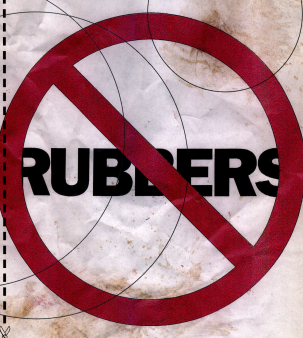
Every Thursday through Sunday night in San Francisco’s Castro district, someone named Marshall uses his house to host a party for other gay men who share a similar sexual interest: no condoms. Admission is $8, and after I pay, Marshall hands me a piece of paper. “This is a bareback party,” the house rules read. “It is assumed all guests are HIV+ or have made the decision to attend this kind of party. Therefore, there will be no discussion of status, illness or medicine.” Partygoers must also sign a statement of their intention not to infect anyone with HIV. Whether or not they mean it, this relieves the host of any responsibility under the new California law that criminalizes HIV transmission. After signing in, I peel off my clothes, stuff them into a white trash bag labeled “Michael S.” in black magic marker and, with a sense of trepidation, proceed downstairs into a large bedroom occupied by a dozen naked men in various positions of sexual activity. A red bulb provides the only light, casting an eerie glow over the room. A TV screen flickers with a porn video. The men are a diverse group, running the gamut in age, ethnicity and body type. Moving between the bodies, I take a seat and watch the center of the action -- two tops take turns with a bottom. The sex is silent, serious and very intense. It continues for what seems like an hour, finally culminating with the two tops each getting off inside the bottom. Afterward, he remains on his hands and knees, waiting for others to mount him. During this pause, I find myself, as a 28-year-old gay man, wondering if this is what carefree sex was like in the ’70s. No one here but me betrays anxiety.
The late writer and porn star Scott O’Hara was the first to lead the barebacking charge. In a 1995 editorial titled “Exit the Rubberman,” in Steam, his journal devoted to sex in public spaces, O’Hara wrote: “I’m tired of using condoms, and I won’t ... , and I don’t feel the need to encourage negatives to stay negative.” The letters from readers -- admittedly a group self-selected for sexual adventurism -- were overwhelmingly favorable. As O’Hara and other HIV positive men restated their positions in such magazines as POZ and The Advocate, there was a sense that they were mining a long-buried, pre-AIDS memory -- the sharing of semen -- and reclaiming its rich symbolic meanings. These anti-condom statements were more than enough to frustrate, infuriate and sadden the majority of gay men who fought so diligently over the years to reduce infection rates while burying their loved ones.
In September 1997 the debate leapt from the gay press into full public view with a piece in Newsweek called “A Deadly Dance.” Soon, former Miss America Kate Shindle was commenting, speculating in a February 1998 Advocate commentary, “Barebacking? Brainless!” that funding for AIDS prevention would dry up if government agencies took notice of gay men’s supposed disregard for public health. Even Vice President Al Gore used the term barebacking in his conversation with the President’s AIDS Advisory Council. In an episode last season of the popular television series ER, a gay sex worker described how his customers paid him extra for bareback sex.
Since its public debut over three years ago, barebacking -- also called raw or skin-to-skin sex -- has been simultaneously condemned and sensationalized by the media. The debate is stuck between two hyperpolarized camps, with antibarebackers screaming, “Dangerous sex fiends,” while barebackers counter with “Condom Nazis.” Meantime, a new sexual subculture has emerged, organized around the no-condoms creed. Driven underground but swelling in numbers, this community flourishes in private houses and especially on the Internet, where its members -- not all have HIV -- can fantasize, experiment and connect with others, free from the stigma attached to openly soliciting unsafe sex.
In a sense, Scott O’Hara and other self-proclaimed barebackers were merely publicizing a widely recognized but rarely disclosed fact. For years now, public health experts have told HIV positive gay men to err on the side of caution by using condoms even with other positives, though the scientific jury on reinfection is still out. While many HIVers have complied -- condom use was viewed in the late ’80s as a virtual communal duty -- many others have not. They are unwilling to abandon an act of such fundamental importance as skin-to-skin sex for an as-yet-unproved harm. Last summer, researchers documented the first case of multidrug-resistant HIV transmission -- from an HIV positive man to his HIV negative partner. AIDS organizations used the case to reissue a condom-code clarion call. Then, in September, a Centers for Disease Control and Prevention epidemiologist made the first scientific pronouncement that reinfection by different strains of HIV is a fallacy. Other researchers immediately disputed these claims. Meanwhile, many gay men with HIV assume that no definitive news is good news, and continue condomless.
Many prevention experts lay the blame for barebacking on protease-based regimens (and, to a lesser extent, post-exposure prophylaxis treatment -- the misnamed “morning-after pill”) for popularizing the idea that AIDS is a chronic, manageable disease, but some barebackers call this passing the buck. “I think barebacking was inevitable,” Zach, a 36-year-old lawyer and barebacker, says. “Protease is helping men live longer, but gay men have finally had it up to here. After 18 years of living in doubt and crisis, men don’t want to face a lifetime of wrapping themselves in latex.” In fact, the emergence of this new sexual subculture also coincides with an ongoing crisis in HIV prevention, including recent attacks on the condom code from such gay psychologists as Walt Odets, PhD, such morality-and-monogamy advocates as Gabriel Rotello and such “post-AIDS” sex-lib theorists as Eric Rofes.
Meantime, advances in treatment continue to multiply the areas of doubt through which gay men wander. The relationship between HIV in blood and HIV in semen remains murky, and many barebackers are left to hope -- but not know -- that an undetectable viral load in their or their partner’s blood might reduce the likelihood of infection. Indeed, the questions prevention experts are most frequently asked are not about basic transmission, but rather these “gray areas” -- oral sex, pulling out, pre-come and so on. The national AIDS establishment’s polarization of all behavior into either “high risk” or “low or no risk” leaves many gay men -- whose behaviors reside somewhere between these extremes -- unsupported in their sexual decisions.
Distinct from an infrequent slip-up, drunken mishap or safer-sex “relapse,” barebacking represents a conscious, firm decision to forgo condoms and, despite the dangers, unapologetically revel in the pleasure of doing it raw. Some people use the word barebacking to describe all sex without condoms, but barebackers themselves define it as both the premeditation and eroticization of unprotected anal sex. Michael McKey, a producer of a new line of bareback porn videos, puts it this way: “Barebacking is an active decision -- and that’s very different from just sort of passively letting unprotected sex happen.”
To barebackers, it’s the meaning of skin-to-skin sex that matters; to antibarebackers, it’s the consequence -- the risk of deadly (and other) diseases. Generally, the public views all barebacking unilaterally as “unsafe sex” and as the opposite of “safer sex.” In my own effort to make sense of why some men choose to eliminate condoms, I’ve found it enormously helpful to consider barebacking in a different framework: like safer sex, on a continuum of “un-safety” with varying degrees of protection and danger (pulling out before ejaculation is less “unsafe” than not). It’s worth noting that as the risk of HIV infection escalates, so do moral judgments. This is why raw sex between positive men is often merely frowned upon, but when the partners are serodiscordant, words like murder and suicide enter the discussion. It also explains the notion that an HIVer who tops is more “guilty” than one who bottoms.
Zach, who is HIV negative, barebacks only as a top when he has sex with positive men -- in his mind, an act relatively low on the “unsafer” continuum. He arrived at skin-to-skin sex through the practice of negotiated risk (a harm-reduction strategy common outside the United States): He’d been in a series of relationships with men where they both repeatedly tested negative and finally dispensed with condoms. “After a few of those relationships, I decided not to use condoms at all anymore,” he says. “Barebacking is an incredible experience, and it’s tremendously difficult to go back to latex.”
But the decision to abandon condom use is not always a one-way street. Dave, an HIV negative man who once threw himself into the latex-free life for several months, is one example: “I decided to stop barebacking because of the potential health risks -- and not just HIV -- although I definitely feel that latex negatively affects my sex life.” But he says he is still very much drawn to raw sex -- “somewhat like a moth to a flame.” Health concerns that drive guys like Dave back to condoms include such STDs as herpes, hepatitis, gonorrhea and anal warts. And for positive barebackers, these STDs can significantly impair the immune system, accelerating the progression of HIV disease. The risk that has placed barebacking at the center of national debates on gay sexual mores, of course, is that of HIV. Many HIV negative men are barebacking, and while some attempt to do it only with other negative men, it’s impossible to be absolutely sure of a partner’s serostatus.
Eighteen years into the HIV holocaust, a gay man -- regardless of serostatus -- is likely to have an immensely complex relationship not only to unsafe sex but to the virus itself. Barebackers like Zach focus on the positive values of semen exchange: “There’s no better way to bond with a man than to give or receive sperm. A lot of bottoms take it into their bodies and keep it there as a way of remembering the sex. They want to feel it inside them and keep experiencing that closeness. It’s a physical expression of intimacy.”
Yet as Walt Odets, William Johnston and other experts on the psychology of HIV negative men have documented, there are also other emotions drawing them to the virus, including survivor guilt, a sense of inevitability about the prospect of seroconversion, an identification of AIDS with gayness, an association of seroconversion with a positive life transformation and more. Pete, a 33-year-old gay man, expresses this ambivalence. “I was so afraid of becoming positive for such a long time,” he says, “and once that happened, I felt relief. I also decided I didn’t want to spend my whole life going without the sex I love the most.” For many, liberation from the necessity of condom use with other positive men presents a certain appeal. A popular and ironic barebacking slogan coined by Stephen Gendin in these pages almost two years ago sums it up: “Membership has its privileges.”
Bare sex’s “moth to a flame” seductiveness has exploded into an elaborate social network that Scott O’Hara could hardly have imagined in 1995. With “health monitors” patrolling commercial sex venues, on the lookout for patrons who dare to break the rules, barebackers have responded by hosting private parties in their own homes. At The Bareback House in San Francisco, Marshall has even created events catering to special interests, including “Fill a Hole” parties, during which one or two designated guests serve as bottoms for the 20-plus tops. Some parties in other cities are arranged for men of a particular serostatus: positive only, negative only or mixed. One invitation instructs participants to wear a bandanna to signify whether they want guys to “unload” in them. Lest anyone believe these parties are confined only to urban gay meccas, they are also organized in cities such as St. Louis, Oklahoma City, Phoenix and Indianapolis.
Websites such as XtremeSex, IRC (Internet Relay Chat) channels and America Online (AOL) chat rooms have sprung up, seemingly out of nowhere. There are now more than 80 different bareback electronic mailing lists (“listservs”) for men of certain body types, geographic locations and shared sexual tastes. The most popular is run by a man named Ed and boasts more than 1,400 subscribers. Ed estimates that 60 percent are HIV positive and the rest are HIV negative or uncertain of their status. To keep the list from erupting into a debate about the moral pros and cons of barebacking, the listserv’s No. 1 rule is no discussions of AIDS. Men can identify their HIV status, but nothing more.
In addition to the Internet, barebackers have appropriated a number of time-honored gay male methods for cruising, including the ’70s system of visually communicating a preference for specific sex acts by wearing color-coded handkerchiefs. After lengthy Internet discussion, barebackers chose their own hanky: dark blue (anal intercourse) with white dots (semen).
While many barebackers are committed to staying uninfected and protecting their partners from HIV, the XtremeSex website caters to those who are not. In operation for more than two years and open to all gay men -- regardless of serostatus -- it highlights the erotic appeal of HIV-infected semen. XtremeSex offers hundreds of personal ads including those from “bug chasers” (men looking to become infected or exposed to HIV) and “gift givers” (men who eroticize infecting or exposing others to HIV). “Hot hard-body muscular bottom looking to be gang-banged by as many poz guys who want it. I will do whatever you want. No limits at all. I need your charged loads” is a characteristic personal on the XtremeSex website.
Rare exceptions to the barebacking norm, these men prize not just unprotected anal sex or even semen but HIV itself as the ultimate intimacy to share with another. In a mind-boggling feat of symbolic reversal, they have taken the dread and deadliness of the virus and transformed it into desire and regeneration. For them, sharing uninfected semen is insufficient because it provides only a temporary bond -- the come dries up, leaving only the memory of the experience. But “charged loads,” in the XtremeSex worldview, offer a kind of permanent partnership, a connection outside of time. Once you’re infected, you’re infected for life. Over and over on the XtremeSex website this fantasy plays itself out, and XtremeSexers have used their considerable knowledge of HIV pathogenesis to elaborate it. From the science of how the virus invades -- and then is incorporated into -- the host cell, combining the DNA of one organism with another to make a new form of life, these men have woven a tale of romance. In this way barebacking is equated with “breeding” and infection with “impregnation.” Some HIV negative bug chasers have gone so far as to attempt to consciously choose the individual gift-giver who will “father” their HIV infection. For these men, seroconversion has become a rite of passage rather than a chance occurrence, couched in metaphors of pregnancy.
One HIV positive man named Paul, 45, is in the process of becoming a gift-giver to a 21-year-old HIV negative sex partner. Paul has delayed “giving the gift.” Though they have had sex without condoms in the past, Paul has never ejaculated inside his partner. He has spent the last few months telling his friend about HIV and its physical and emotional consequences. “I’ve talked with him for quite some time so that he understands what he’s getting into, and evidently he feels it’s controllable and wants it,” he says. “As long as he is clear on what he’s asking for, I’d love to drain a load up his hole. It turns me on knowing how much he wants my come and how much he’s willing to deal with to get it.”
When pressed, Paul acknowledges the “twisted romantic” nature of their relationship and the unequal power dynamics of their difference in age. His tone of voice, so matter-of-fact, is almost as disturbing to me as what he has to say.
The gap between public HIV prevention messages and gay men’s behavior behind closed doors is wider than ever, for a number of reasons. Most early prevention strategies were grounded in fear and shame, disallowing honest discussion of behavior that deviated from the condom code. Current campaigns continue to paint such broad brushstrokes (“Use a condom every time”) that the audience for this social marketing either tunes out or fails to identify with the message. Further, a resistance to most harm-reduction strategies in the United States has disempowered men from making informed choices about the level of risk with which they are comfortable. It’s worth noting that extensive barebacking subcultures do not exist in other countries such as Australia where sex-positive harm-reduction models were instituted early on.
Offering his take, Zach, a former AIDS service organization professional, says, “In other countries they focus on saying, ’If you get fucked by someone whose status you don’t know, use a condom and don’t let him come in you. Period.’ But they don’t try to scare you about oral sex, pre-come and reinfection.”
Many barebackers believe their subculture has coalesced in large part as a backlash against all this. “What we’re seeing now on the Internet is just the beginning,” Zach says. “AIDS groups are so out of touch with their communities. They should think less about where they’re getting their funding and more about the communities they’re supposed to serve. They need to get a grip on our reality. Otherwise, it’s going to get a lot worse.”
Rather than scapegoating barebackers for the shortcomings of HIV prevention campaigns, a more productive approach would entail outreach workers familiarizing themselves with the subculture. Like it or not, as Zach says, men will continue to bareback, and they deserve a set of noncondom strategies to help reduce the harm. Acknowledging that “unsafer” behavior has its own continuum, a harm-reduction approach to barebacking would enable men to make more informed choices. For a presentation at last year’s National Lesbian and Gay Health Association Conference in San Francisco, I crafted a draft model of “Safer Barebacking Considerations.” This approach has raised the ire of old-guard administrators in the mainstream AIDS establishment. Tom Coates, MD, director of the Center for AIDS Prevention Studies at University of California, San Francisco, likens it to “strategies for reducing the potential for killing someone while driving under the influence of alcohol,” he says. “People may make lots of decisions, but that doesn’t mean that we should endorse them, especially without data.”
In his response to the “Safer Barebacking Considerations,” Devin Kordt, founding director of Aggressive AIDS Prevention in San Francisco, asks, “If the individuals do not value proven prevention methods for anal sex, i.e., condoms, what makes you think they want the equivalent of a personal lube endorsement?” In other words, Kordt asserts that because barebackers have rejected one prevention strategy, they will reject all others in their indiscriminate recklessness.
The controversy continues with a growing recognition that barebacking is neither a fad nor a glamorous buzzword. It remains to be seen how politicized barebackers will become about their rights and responsibilities. While it’s unlikely that a contingent of bareback advocates will march in this year’s gay pride parades, this community is increasingly visible. Take the example of “Xtreme ’99.” Billed as a national barebacking “convention,” it’s a weekend gathering this April in Dallas, Texas of hundreds of men from all over the United States and other countries for bareback sex.
Before I attended barebacking parties, I believed I had mentally prepared myself for what I would encounter, but my experiences left me with a mix of intense emotions -- fascination, desire and dread. Perhaps most frightening was my temptation to join in the skin-to-skin action. But I limited my sex to what I usually do in the absence of condoms -- blowjobs. Why? After much reflection, I see that to me, the social stigma attached to writing honestly about such an experience seems almost as damaging as the health risks involved. While I had previously written about and intellectualized barebacking, I was nonetheless taken aback by the reality of being surrounded by the act.
My own thoughts on barebacking have shifted radically in recent months, especially in regard to my stereotypes about the men themselves. After the barebacking parties, I was overwhelmed by what I perceived to be sex without limits, a lack of critical thinking and short-sighted hedonism. Later, interviewing and interacting with barebackers made me realize that they possess personal ethics, political consciousness and self-control in addition to the relative extremity of their sex.
These experiences have led me to believe that barebackers do not deserve to be vilified, but rather more fully understood, and the very real problems to which barebacking may contribute should also be examined. In essence, barebacking represents the classic conflict inherent to public health. But there’s great difficulty in balancing rights for people who make choices that are “extreme” with the potential for collective burden and actual cost to be born by all of us. A harm-reduction approach is merely the beginning, and doesn’t address what is perhaps the greatest danger currently surrounding barebacking: the inability of community members and leaders to discuss these issues with mutual understanding and respect.
SAFER BAREBACKING CONSIDERATIONS
This is not a set of HIV prevention guidelines. Intended only for gay men who have already decided not to use condoms for anal sex, these strategies may help reduce the harm associated with barebacking, some advocates believe. Here, harm should be interpreted more broadly than HIV infection; these tips may also help reduce the risk of other STDs. Bear in mind that much of this information is anecdotal and debated by researchers.




1 Comment
1 Comment